


The Indoor Climate Label
What is the Indoor Climate Label?
The Indoor Climate Label shows at a glance what a building’s indoor climate is like. It also gives building owners the assurance that the performance requirements are being met.
The Indoor Climate Label assesses this on the basis of four criteria, based on the Specifications for Healthy Offices:
- Air
- Light
- Climate
- Sound
The building’s performance across these four areas is made transparent through the Indoor Climate Label. You receive up-to-date insights 365 days a year, based on data from sensor technology and user feedback. The Indoor Climate Label has five tiers: A to E, with A being the highest achievable level and E the lowest. The Indoor Climate Label is awarded to buildings if they achieve at least a C; otherwise, the indoor climate is deemed unsatisfactory.
Why an Indoor Climate Label?
How do you know if the indoor climate in your office is healthy and comfortable? With the Indoor Climate Label, you can assess the indoor climate in your office and make it easier to create a healthy indoor environment! The Indoor Climate Label gives you an insight into how healthy and comfortable your office is through monitoring and feedback from your staff. It is important that your office has a healthy indoor climate with good ventilation, as this makes staff more productive and results in lower absenteeism (RVO, 2012). The Indoor Climate Label is the ultimate solution for improving your office and promoting the health and productivity of your staff.
What exactly does the Indoor Climate Label measure?
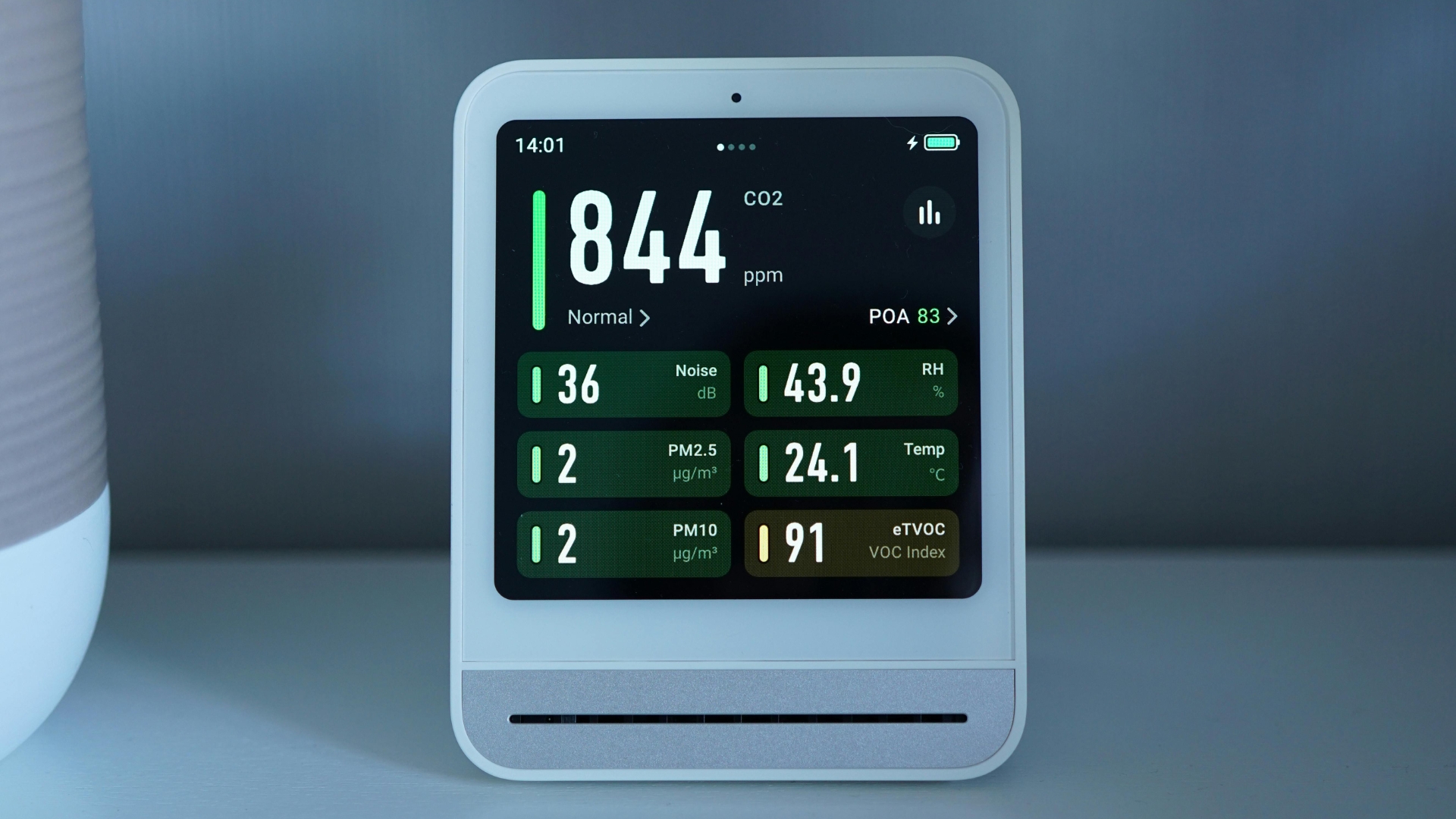
The Indoor Climate Label assesses lighting, climate, noise and air quality on the basis of performance requirements. Climate and air quality are measured by sensors. Lighting and noise are assessed using a questionnaire. The sensors must measure at least the following elements:
- Temperature [°C]
- CO₂ [ppm]
- Relative Humidity (RH) [%]
- Particulate matter – PM2.5 [µg/m³]
Who is the label aimed at?
The label is intended for, amongst other things, offices, childcare centres and care complexes; the Indoor Climate Label is therefore specifically aimed at building managers, facility managers or building owners who wish to improve their buildings. The Indoor Climate Label can help you make your building healthier and more comfortable, which can also help to reduce absenteeism.
What standards or guidelines form the basis for this?
The Indoor Climate Label is based entirely on the standards and guidelines set out in various Specifications of Requirements drawn up by the Indoor Climate Technology Foundation. For offices, it is based on the Healthy Offices Specification of Requirements.
How is the label awarded?
Following two months of continuous monitoring data and the survey, a provisional label may be issued. The definitive label will be issued after one year, as it is only then that all monitoring data covering the four seasons will be available. The survey must be conducted at least once a year.
Benefits of the label in practice
- Insight into the indoor climate in your office. Monitoring provides real-life data (to measure is to know)
- Lower absenteeism
- Higher productivity
- A healthier office
- A more comfortable office

Frequently Asked Questions
Here are some of the frequently asked questions about the Indoor Climate Label. Do you have any other questions? If so, please contact us.
-
What is the Indoor Climate Label?
The Indoor Climate Label shows at a glance what a building’s indoor climate is like. It also gives building owners the assurance that performance requirements are being met. The Indoor Climate Label does this by assessing four key areas, based on the Healthy Offices Specification: Air, Light, Climate and Noise. Through continuous monitoring and user feedback, you gain insight into your building’s indoor climate.
-
For which buildings is the Indoor Climate Label suitable?
The Indoor Climate Label is currently suitable for offices, healthcare facilities and childcare centres, but may in future also be suitable for homes and schools. These different types of building often require a different approach, which is why the Indoor Climate Label is currently focused primarily on offices.
-
How long is the Indoor Climate Label valid for?
Once an Indoor Climate Label has been issued, it is valid for one year. Based on the survey and the continuous monitoring data, the label will be reassessed once this period has expired to determine what it should be. Should the label change on the basis of the new data, it must be updated.
Example:
- 1 January 2026: The building is equipped with all the necessary measuring equipment.
- 1 March 2026: After two months, the building is awarded a provisional Indoor Climate Label C, based on continuous monitoring and a survey.
- 1 January 2027: The final label is issued for the building. In this case, for example, it is once again Indoor Climate Label C. The Indoor Climate Label C for this building is now valid until 1 January 2028.
- 1 January 2028: Based on continuous monitoring throughout 2028 and a new round of feedback via the survey, the Indoor Climate Label is reassessed. In this case, the assessment shows that the new label is an Indoor Climate Label B. This Indoor Climate Label is once again valid for one year, i.e. until 1 January 2029.
-
How much does an Indoor Climate Label cost?
The Indoor Climate Label has three types of cost items:
- One-off investment (via a technology partner)
- Purchase of measuring equipment: Smart CO₂ and particulate matter monitors that also measure temperature and humidity.
- Consultancy and installation costs for sensor technology: These depend on the size of the building or room and on the technology partner.
- Annual software costs for technology partners
- Software costs: For access to the dashboard and insight into the measurement data. These costs depend on the size of the building or space and on the technology partner.
- Annual costs for the Indoor Climate Label
- Basic management costs: For the management and further development of the Indoor Climate Label.
- Certification fee: For the use of the Indoor Climate Label methodology, including the questionnaire.
- The annual costs for the Indoor Climate Label are set out in the table below:
Number of buildings Price per building 1 – 5 €100 6 – 10 €80 11 – 25 €60 26 – 50 €40 51 – 75 €30 76 – 100 €25 101+ €20 - One-off investment (via a technology partner)
-
How soon after submitting my application can my building be awarded a label?
Once all the sensors have been installed, a provisional label may be issued after two months. This will be based on the survey and the continuous monitoring data collected over the two-month period. The final label will be issued after one year, as this is when all the monitoring data covering the four seasons will be available. This is particularly important for obtaining an accurate estimate of the temperature.
In addition, the speed of the process depends on a number of different factors. For example, the type and size of the building can influence how quickly your building can be awarded a label. In larger buildings, more measuring equipment needs to be installed, which can take longer. It also depends on how busy the Indoor Climate Label’s partners are. The partners can provide a more detailed estimate of the processing time for your specific building and circumstances.
-
Which buildings already have an Indoor Climate Label?
You can easily see which buildings already have an Indoor Climate Label on this page.
-
Who are the founders of the Indoor Climate Label?
The Indoor Climate Label is part of the Indoor Climate Technology Foundation.
-
My question isn’t listed here – how can I get in touch with you?
If your question has still not been answered, please contact us via the contact form.