

The office as a revenue model
Friday 17 June 2022 – Health is taking centre stage in the office. The platform Indoor climate control That is why it developed the Indoor Climate Label. Ruud Hennep of BGW Advies explains.
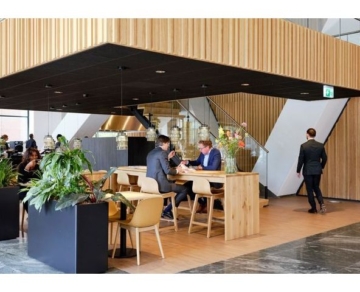
Over the years, the role of the office building within the workplace experience has changed for office users. Due to various factors, the office has evolved from a place where administrative tasks were carried out to a place where people feel comfortable and safe and can find inspiration. For example, the offices of many tech companies now offer relaxation areas and the option to work in a variety of ways (open-plan or quiet working areas).
As a result, the firm’s reputation has become a key factor in attracting good staff. Alongside salary and career progression opportunities, the workplace has become a decisive factor.
Coronavirus pandemic
The coronavirus pandemic is changing the role of the office in various ways. The property consultancy CBRE states: “Offices will continue to be designed and used differently, even once the virus is no longer a threat. Among other things, flexible working is becoming increasingly commonplace, buildings are being made smarter, there is a much greater focus on health and hygiene, and we need to redefine what maximum occupancy means.”
Whatever form the office ultimately takes, health will play a major role within it. An office should be a place where people can work safely; in other words, it should have an indoor climate that does not cause complaints or pose a health risk.
Indoor Climate Label
In order to demonstrate that an office building can be classified as healthy, the platform has Indoor climate control, an initiative of TVVL and Indoor Climate in the Netherlands, the Indoor Climate Label has been developed. The guidelines set out in the Specification of Requirements (SOR) for Healthy Offices. The ‘Healthy Offices’ Performance Criteria are a guide for the (re)development of offices that must not only be energy-efficient, but also healthy and comfortable.
An office meets the standards of the Indoor Climate Label once it has been assessed against four criteria from the ‘Healthy Offices’ Specification: air, light, climate and noise. Three levels of ambition have been defined for these four criteria. Class C indicates ‘satisfactory’, Class B means ‘good’ and the highest rating is Class A, which is ‘very good’. The label can be used to determine the current status of the office and to take the necessary steps to improve the situation.
Obtaining the Indoor Climate Label
Obtaining the label involves two stages:
- User satisfaction
- Continuous monitoring
However, in order to handle the results of the user satisfaction survey effectively, the use of a proper complaints registration system is strongly recommended.
What are the benefits of a healthy building?
As mentioned earlier, the COVID-19 pandemic has highlighted the vulnerability of the indoor environment. However, there are other reasons to ensure a good indoor environment. Two very important factors in this regard are increasing productivity and reducing absenteeism due to illness.
Increased productivity
It has been scientifically proven that a good indoor climate leads to a productivity gain of between 10 and 15%. This can quickly result in a significant improvement in results, as shown in the calculation example.
Calculation example: Employee productivity
- An employee works 40 hours a week.
- That works out as follows per year: 52 weeks × 5 days × 8 hours. 2,080 hours
- That’s 6 working days: 6 × 8 hours – 48 hours
- And 25 days’ holiday: 25 × 8 hours. -200 hours
- The maximum number of available working hours is therefore: 1,832 hours
- Not everyone can be 100% productive. There are meetings, for example. You should therefore set your own productivity target – say, 80%.
- The estimated number of productive hours is therefore 80% × 1.832 = 1,465.6 hours
- The budgeted hourly sales rate is €100. x €100
- The estimated annual revenue per employee: €146,560
- With a productivity gain of 10%, this translates to a gain of €1,465 per employee!
Reducing sickness absence
20% of sick leave is caused by a poor indoor environment. Reducing sick leave will result in significant savings, as shown in the calculation example.
Sample calculation: employee’s healthcare costs
- Continued payment of wages: €153
- Replacement cost: €146
- Loss of production/service: €43
- Cost of occupational health and safety services: €60
- Absence support €7.50
- Total costs of absenteeism: €409.50 per day
Based on an average annual income in the Netherlands of 36,500 euros (CPB figures).
The future of offices
Due to the coronavirus pandemic, offices are virtually empty. As a result of the mandatory work-from-home period, many offices are no longer accessible. At present, it is still very unclear how companies are managing working from home. This will undoubtedly have an impact on office usage once the lockdown is lifted. The role that the office building will play within the organisation depends on various factors, including corporate culture.
There is one thing on which building users, owners and employers all agree: the office building must be ‘healthy’. Naturally, it must also be possible to demonstrate that the building is in fact ‘healthy’.
This means that the Indoor Climate Label is currently the building label available. It is a label specifically designed for the indoor climate in office buildings.
Latest news
First office with a certified Indoor Climate Label
14 June 2022
The office as a revenue model
17 June 2022